Ave Maria is the Latin greeting that means Hail Mary. On a Christmas program it can mean two different pieces of music, and listeners often love both without knowing they started in different centuries. One is Franz Schubert's song from 1825, written for a scene in Walter Scott's poem The Lady of the Lake. The other is Charles Gounod's melody from the 1850s, laid over a keyboard prelude Johann Sebastian Bach wrote in 1722. Neither work was composed as a carol. Both became holiday music because the words speak to Mary, the mother of Jesus, and because the tunes are calm enough for a candlelit church or a quiet living room.
This page gathers the story, the words people actually sing, and five recordings that keep the piece in seasonal rotation. If you are building a set list for a parish concert in Kenton County, or you simply want the verses in front of you while a record plays, start here and then use the player and sheet music spaces below.
Schubert setting
Franz Schubert, 1825. Song catalog D 839, Opus 52, Number 6. Voice and piano. Original German text by Adam Storck, after Walter Scott.
Bach and Gounod
Bach prelude from 1722. Gounod melody published in the 1850s. Standard Latin Hail Mary prayer. Often heard with violin, cello, or organ.
Holiday place
A fixture of Christmas albums, midnight services, and school winter concerts, even though the first audiences were not celebrating the Nativity.
How a Highland prayer became a Christmas song
Franz Peter Schubert was born in Vienna on 31 January 1797 and died there on 19 November 1828, at 31. In the spring of 1825 he was staying in Upper Austria and reading Scott. The Lady of the Lake, published in 1810, is a narrative poem set in the Scottish Highlands during the reign of James V. In the third canto the heroine, Ellen Douglas, hides in a cave with her exiled father. Scott gives her a hymn to the Virgin. A Protestant author wrote a Catholic character's prayer, and that prayer is already titled as a hymn to Mary in the poem.
The German translator Adam Storck published his version of the poem in 1819. Schubert set seven songs from that translation. The sixth of the set, Ellens dritter Gesang, is the piece the world now calls Ave Maria. Ellen's first line is Ave Maria, Jungfrau mild, which is Hail Mary, mild maiden. The rest of the German poem is not the church prayer. It is a frightened daughter asking protection for herself and her father until morning. Schubert wrote it for voice and piano. Publishers issued the Scott songs in 1826. The familiar home key for the song is B flat major, though singers transpose it freely.
The opening Latin words were enough to pull the melody toward the liturgy. Within a generation, singers began fitting the canonical Hail Mary to Schubert's tune. That swap is so common now that many listeners think Schubert set the prayer on purpose. He did not. His manuscript follows Storck. The Latin adaptation is a later performance tradition, and it is the tradition you will hear on most Christmas records. In many dioceses the song stays in the concert half of a holiday evening rather than inside the Mass itself, because it began as a lied, a German art song, not as a liturgical chant. Local custom decides the rest.
The other Ave Maria, by Bach and Gounod
If the accompaniment is a rolling pattern of broken chords in C major, you are probably hearing the other Ave Maria. Bach wrote that pattern as the first prelude in The Well Tempered Clavier, Book I, in 1722. It is cataloged as BWV 846. The prelude has no vocal line. It is a study in harmony, calm on the surface and very carefully voiced underneath.
Charles Gounod, born in 1818, improvised a long vocal melody over that prelude in 1853. The first published form was a meditation for violin or cello and keyboard, not yet a sacred song. A family story sits behind the prayer text. Gounod had written a different poem under the notes for a student singer. Her mother in law, Aurélie Jousset, thought the sentiment was too personal and sent the music back with the Latin Ave Maria written in its place. By 1859 the prayer text and the Bach prelude were traveling together under Gounod's name. He lived until 1893, long enough to see this short piece become his best known work, which did not entirely please him.
Gounod's setting fits the church prayer almost line for line. Schubert's setting fits a dramatic scene and only borrows the greeting. That is why a program that lists both titles is not repeating itself. One is a Highland shelter prayer poured into a Viennese song. The other is a Parisian melody poured into a German keyboard prelude, then given the rosary text. Christmas concerts program them for the same reason weddings do. The tempo is unhurried, the range is grateful for a trained voice, and the subject is Mary.
Why it belongs on a Christmas page
Ave Maria does not mention shepherds, stars, or a manger. Its claim on December is theological and practical. The Nativity stories name Mary as the mother who receives the child. A prayer addressed to her sits naturally beside carols about Bethlehem, especially at a Lessons and Carols service or at the close of a parish concert. Choirs also like the piece because it gives a soloist a real aria without asking the whole room to learn a new refrain.
Record labels noticed the same fit. Holiday albums from opera stars and pop singers have carried one version or the other for decades. Josh Groban placed Ave Maria fourth on Noël, released 9 October 2007. That album was the best selling album of any kind in the United States in 2007, later certified six times platinum, and Nielsen Music later counted about 6.32 million United States copies by December 2022. Celine Dion placed an Ave Maria, credited to Gounod and produced by David Foster, on These Are Special Times, released in November 1998. That album is also six times platinum in the United States and sits among the country's best selling Christmas albums. The song did not need a sleigh bell arrangement to become seasonal. It needed a voice, a church acoustic, and a month when people already had Mary in mind.
Lyrics
Three texts matter. The Latin prayer is what most holiday singers use with either melody. Scott's English hymn is the poem Schubert was actually setting, by way of Storck's German. The German is the original sung text of Ellens Gesang III. All three are old enough to be in the public domain. Modern pop adaptations sometimes add new English lines. Those lines can be under copyright, so they are not printed here.
Lyrics presented for educational and personal use. Sing along responsibly this holiday season!
A short English sense of the prayer
Hail Mary, full of grace, the Lord is with thee. Blessed art thou among women, and blessed is the fruit of thy womb, Jesus. Holy Mary, Mother of God, pray for us sinners, now and at the hour of our death. Amen. Scott's scene is more specific. Ellen is not in a chapel. She is in a rock shelter, asking that cruel men stay outside until morning, and asking that a daughter's prayer cover a father as well. When a pop singer mixes the two, as Celine Dion does on These Are Special Times, you hear the maiden mild lines and then the Latin prayer in the same track.
iTunes Preview player
Five recordings listeners return to
Popularity here means the versions a general Christmas audience is most likely to recognize, not a ranked chart that changes every week. Exact stream counts move daily. Treat the figures below as album context, and refresh any live totals before you publish a statistic in a caption.
Luciano Pavarotti
Pavarotti's Schubert Ave Maria is the recording many people mean when they say the song sounds like Christmas and like the opera house at the same time. He recorded it with orchestra, including a well known account with the National Philharmonic, and it has been reissued on holiday compilations for decades. The tenor sound is open, the tempo is spacious, and the Latin text is the one casual listeners expect. One widely circulated orchestrated upload has gathered well into the tens of millions of plays, though that number is not a fixed chart position.
ListenAndrea Bocelli
Bocelli has returned to Schubert's Ave Maria in the studio and in large outdoor concerts, including sacred album projects and holiday nights with orchestra. His approach is closer to a popular sacred song than to a strict lied recital. Diction stays clear, the line is long, and the arrangement often adds harp or strings that fit a December program. For many listeners under 50, this is the version that arrived through television specials rather than through a classical radio hour.
ListenCeline Dion
On These Are Special Times, released in November 1998, Dion sings the Gounod Ave Maria with a David Foster production. Her official track note credits Gounod, and the lyric blends Scott's maiden mild stanza with the Latin prayer. The album has been certified six times platinum in the United States and ranks among the best selling Christmas albums in the country. The performance is pop in the best sense: intimate microphone work, a wide dynamic rise, and no attempt to sound like a cathedral choir.
ListenJosh Groban
Groban's Ave Maria is track 4 on Noël, released 9 October 2007, and it runs about five minutes and seventeen seconds. Noël spent five weeks at number one on the Billboard 200, was the best selling album in the United States for 2007, and later reached six times platinum, with about 6.32 million copies counted in the United States by December 2022. The vocal sits in a warm baritone range, the orchestra is full, and the track is built for repeat December play rather than for a one time recital.
ListenMaria Callas
Callas recorded Gounod's Ave Maria, and her version remains a reference point for listeners who want the prayer rather than the Highland scene. The tone is darker than the pop crossover accounts, the vibrato is part of the style, and the Bach prelude pattern is easy to hear under the voice. It is not a Christmas album track in the modern playlist sense, yet it is one of the recordings teachers still play when they explain why this short meditation outlived most of Gounod's larger stage works.
ListenA note on other versions
Beyoncé released a song titled Ave Maria in 2008 on I Am... Sasha Fierce. It is a new piece that refers to the prayer, not a straight performance of Schubert or Gounod, so it is outside this top five. Vladimir Vavilov's so called Caccini Ave Maria is another famous melody, written in the twentieth century and often mislabeled. It is beautiful, and it is a third work entirely.
Sheet music
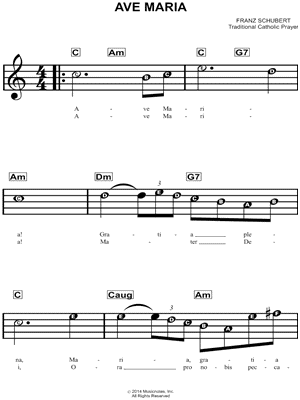
Listening without mixing up the two songs
A useful test takes about eight bars. If the piano begins with a repeated gentle pulse and the singer enters on a rising plea, you are likely in Schubert's song. If the keyboard rolls a steady pattern of broken chords and the melody floats above it in long notes, you are likely in Bach and Gounod. Schubert's original German keeps coming back to Ave Maria as a refrain between verses about the rock, the night, and a father. Gounod stays with gratia plena, benedicta tu, and the prayer for the hour of death.
Either piece rewards a small room. A piano and a single voice are enough. Organ and violin are enough. A full orchestra is a luxury, not a requirement. In a Northern Kentucky church hall, the practical choice is often the key that suits the soloist on the schedule, not the key in the first edition. Schubert wrote for a voice that can float a soft high passage and still speak the words. Gounod asks for a long breath and a steady center. Both forgive a singer who would rather be understood than loud.
If you are singing along at home, the Latin prayer is the safer text for a mixed group, because it is short and many people already know the shape of it from the rosary. Scott's English is the better text if you want the story Schubert actually set. Print one version for the room, not both, or the second verse will splinter. And if a guest starts the other melody, let them finish. Correcting Ave Maria in the middle of a living room is a poor way to keep the peace in December.